Kids grow. New possessions arrive. Old habits disappear. 


 Our dining room pony-wall bookshelf has been (re)optimized so many times that a walk-through of notable versions is warranted.

 Even perfectly organized spaces are never truly “finished” !
An unexpectedly useful corner. I originally designed this built-in just to disguise a structural post.
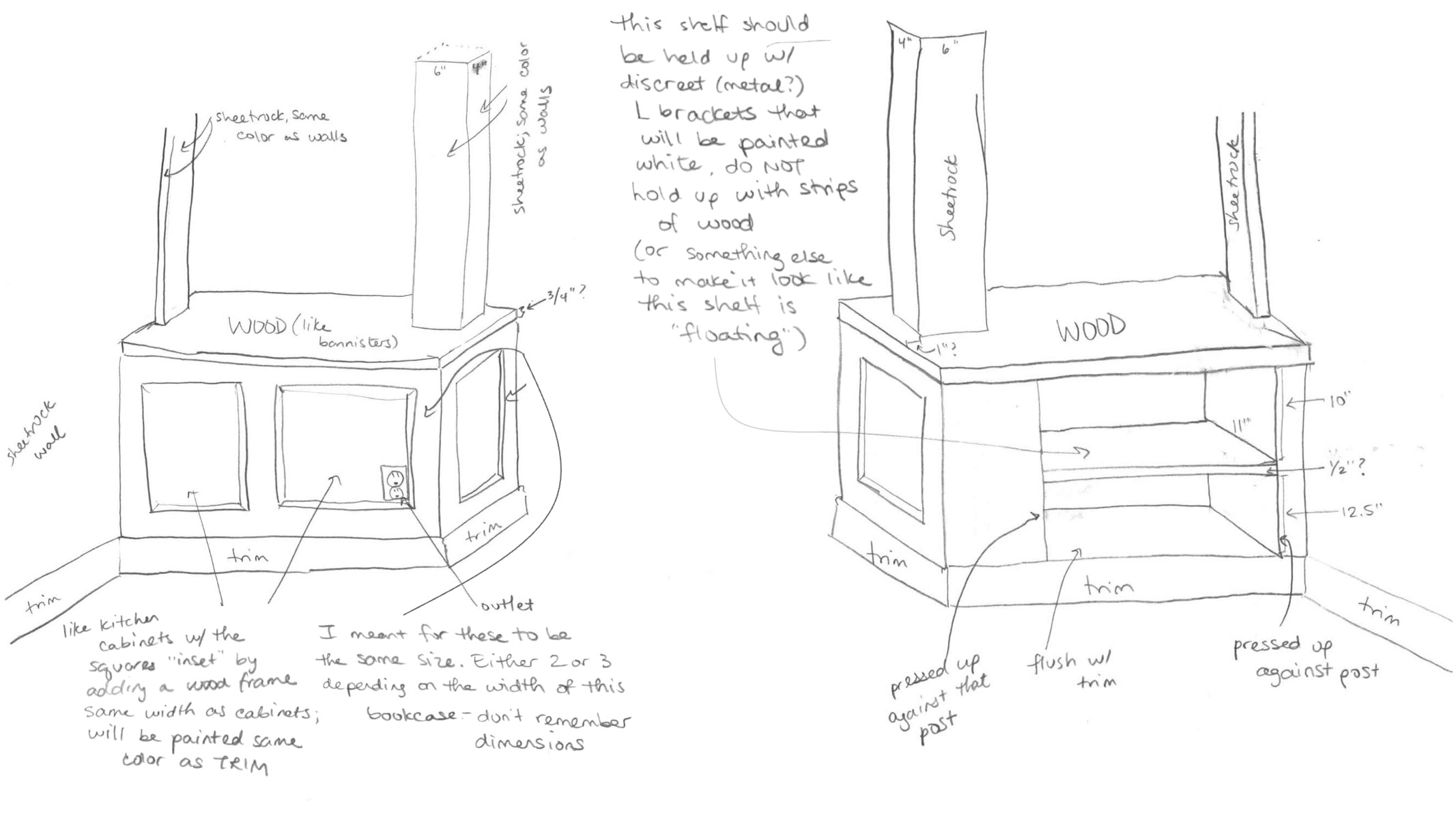
 Drawn on my bus to work, since our contractor needed a design decision ASAP when they discovered this immovable post while taking down a wall.
This afterthought project serendipitously turned out to be the perfect setup for enabling kids’ independence with messy activities:
-
 kid accessible
 -
only 11” deep
-
adjacent to the spill-ready dining table
-
near a sink and broom


Jump ahead to read about our current (version 3!) setup, newly optimized for 4- and 7-year-old schoolkids!
Initial Commit: Bookshelf for Books
When we first moved in with our 6-month-old, we thought books were a perfectly reasonable thing to store on a bookshelf.
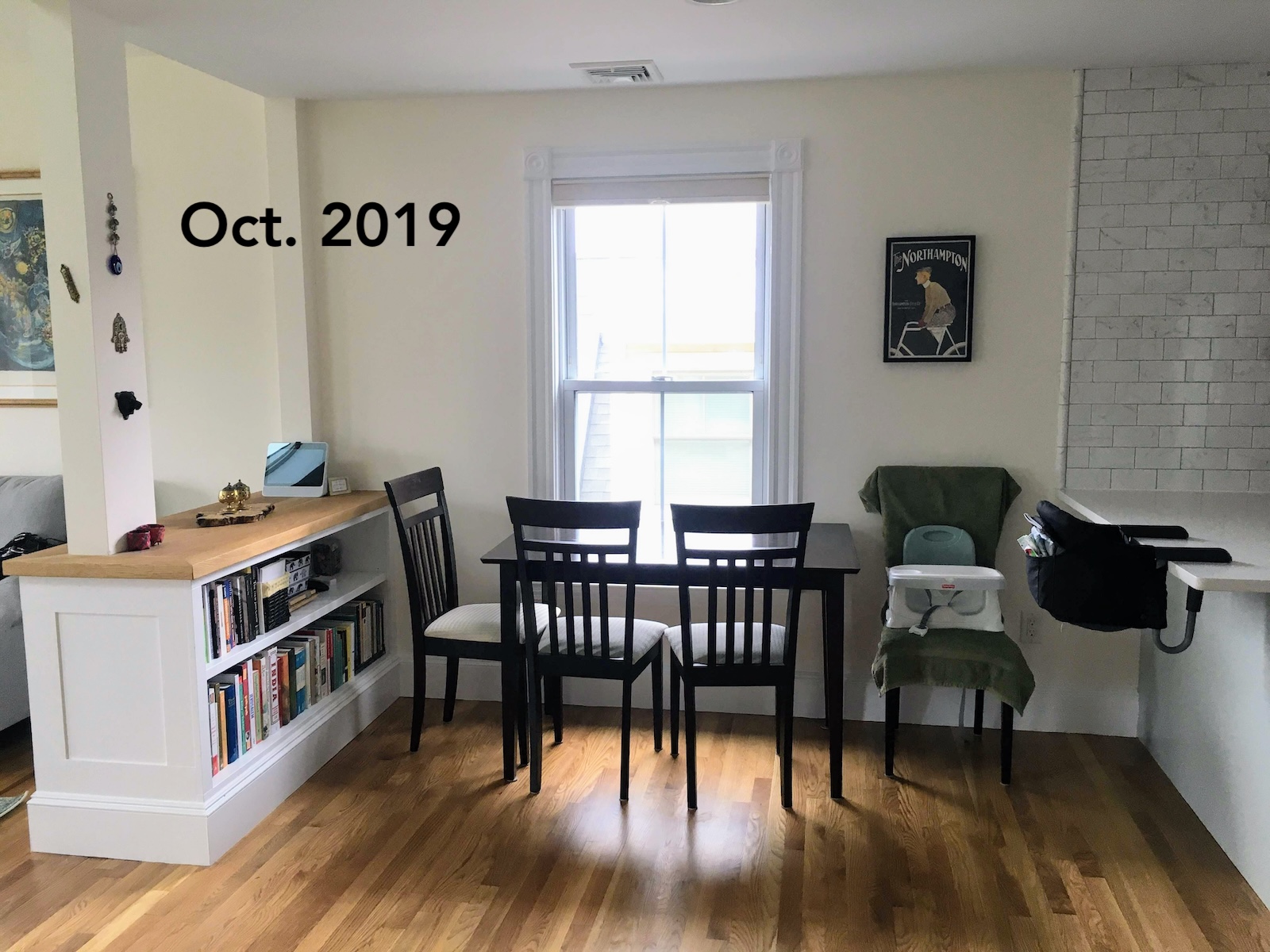
…Parent amateurs.  In no time at all, our kiddo was pulling up onto the shelf
  , and pulling down all the books
  !
! 
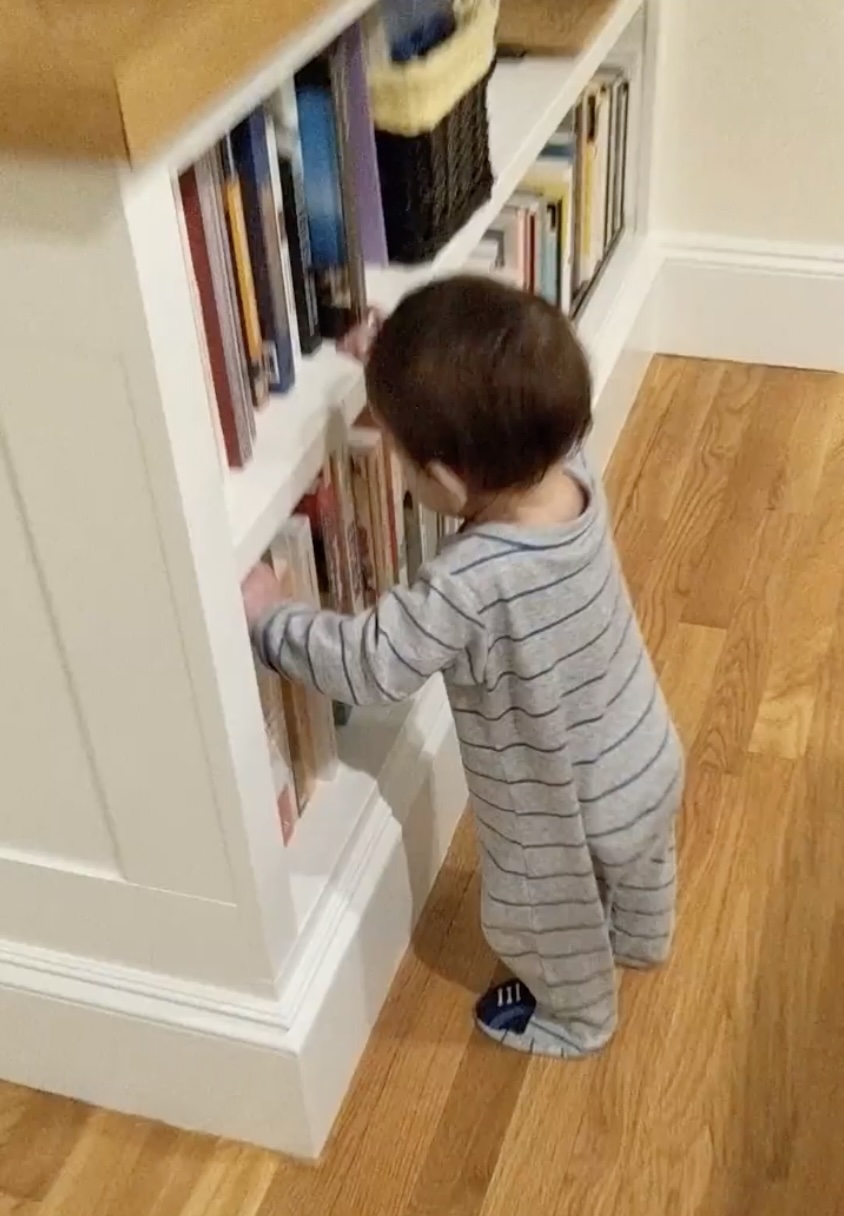
We moved the books upstairs and started keeping kids’ games and art activities here, instead. 
Second Commit: Babyproofing Toddler Activities
In what felt like another blink, kiddo #2 had arrived. Our older son’s games were not baby-safe, and the art supply stash was reaching critical overload. 


Problem 1: Swallowable game pieces. Games needed to be toddler accessible (and put-away-able) but still baby-proofed. These 4x6 photo boxes were ideal! 
Problem 2: Drawing tools are messy. These Ikea glis boxes are light, easily opened and closed (with small hands), and otherwise stay shut. 
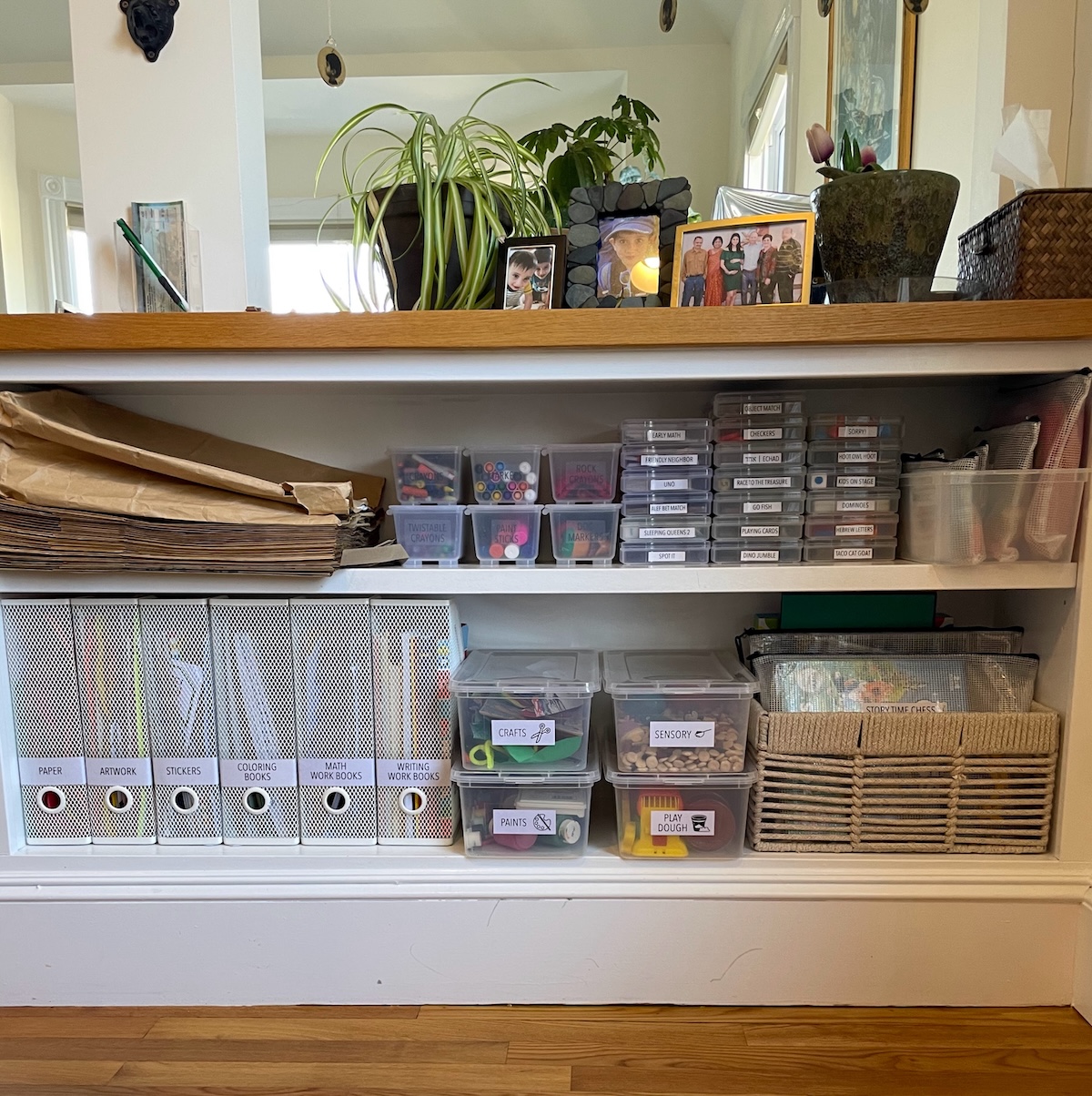
Problem 3: Workbooks need protection. Six (indestructible) metal magazine holders held workbooks and became one of the more frequently modified components of our system:
| v2.1: Tiny Kids | |
|---|---|
| + Mess protection, Artwork, Paper, Stickers, Coloring Books, Workbooks | − |
| v2.2: We Have a Preschooler! | |
| + Math, Writing | − Mess protection, Workbooks |
| v2.3: Kids Can't Share... | |
| + Shared, Rami, Tal | − Coloring Books, Math, Writing |
| v2.4: Real Homework Begins | |
| + Writing/Drawing, Math/Chess, Language | − Shared, Rami, Tal, Paper, Stickers |
“Artwork” has been our only bin constant… I stuff the kids’ art in here, and when it’s finally too full, we play “keep or rid” to make space. 
Third Commit: Two Schoolkids, More Stuff
Fast-forward, and suddenly our younger kiddo is in preschool!  This came with new goodies and new challenges.
Here’s how our pony-wall bookshelf is currently optimized:
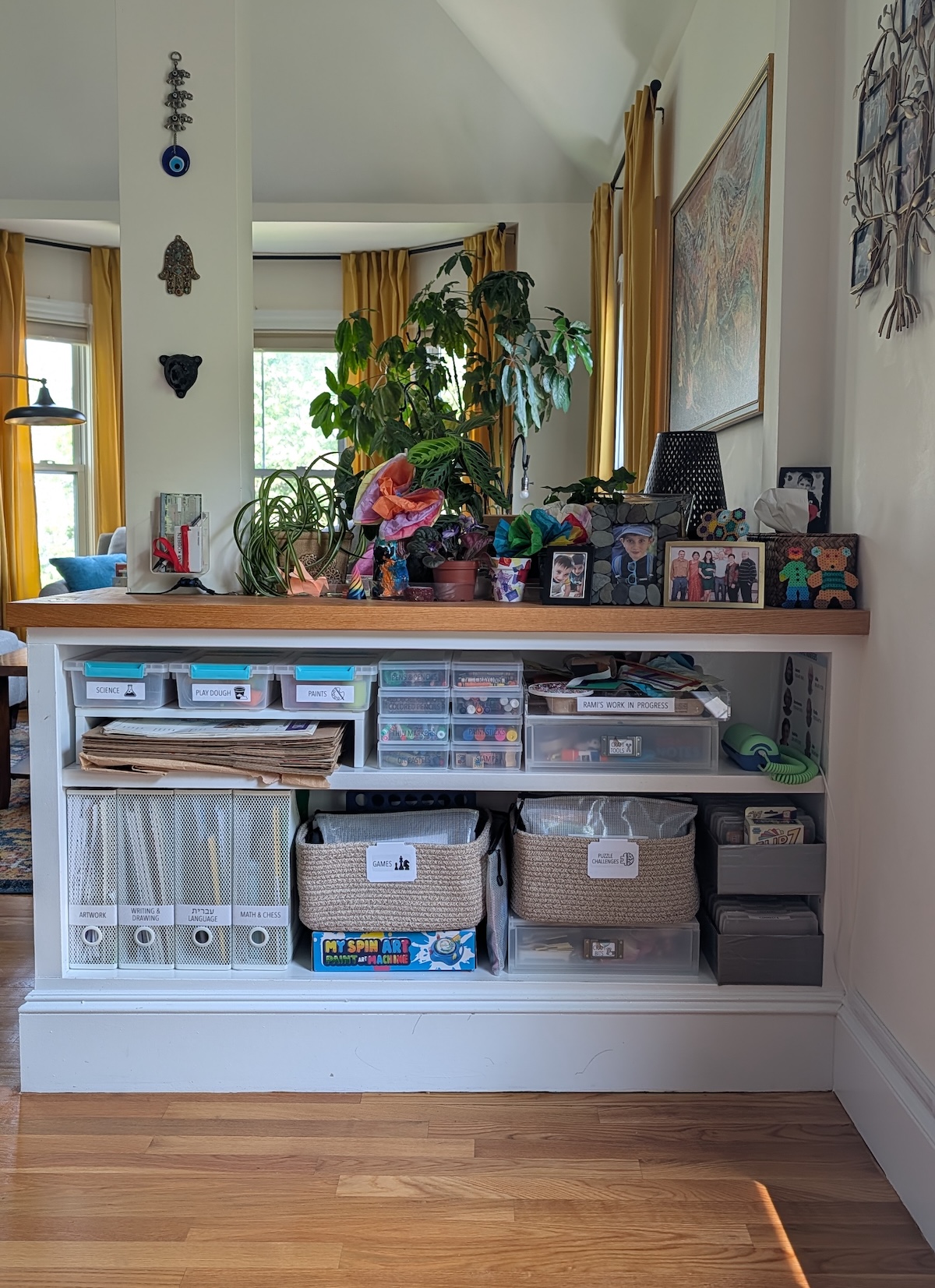
v3.0: Organization Details
In a recurring theme (of life), solving one problem tends to create new problems:
| Problem 1: Big Crafting Tools | Fix-for-Now |
|---|---|
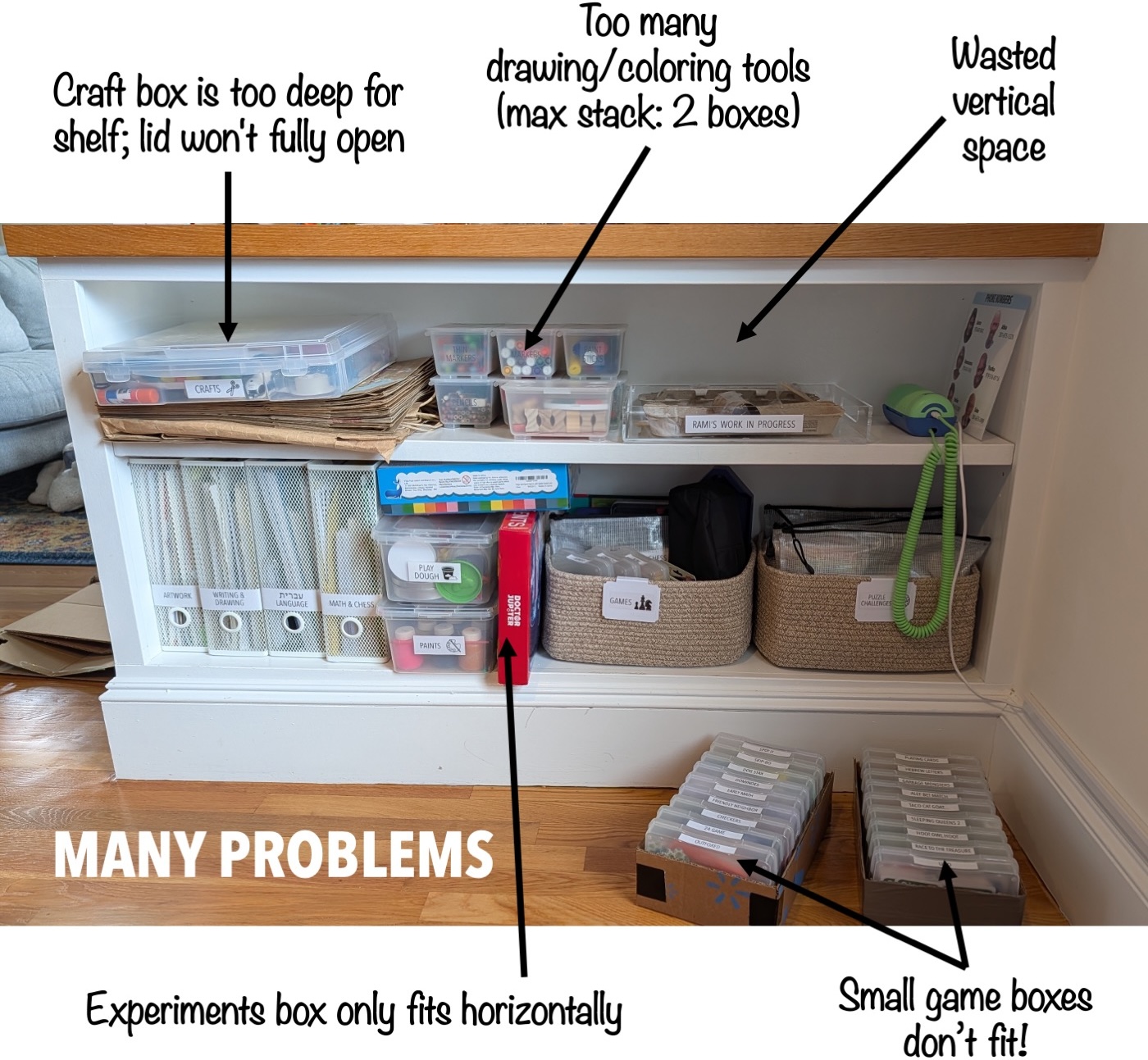
 Most favorite paper cutter is too long for existing shoeboxes Most favorite paper cutter is too long for existing shoeboxes
|
Found a 14” craft box! |
↳ …  “Amma, where’s XYZ?” since bin can’t fully flip open “Amma, where’s XYZ?” since bin can’t fully flip open↳ …  Bin sticks out past shelf Bin sticks out past shelf |
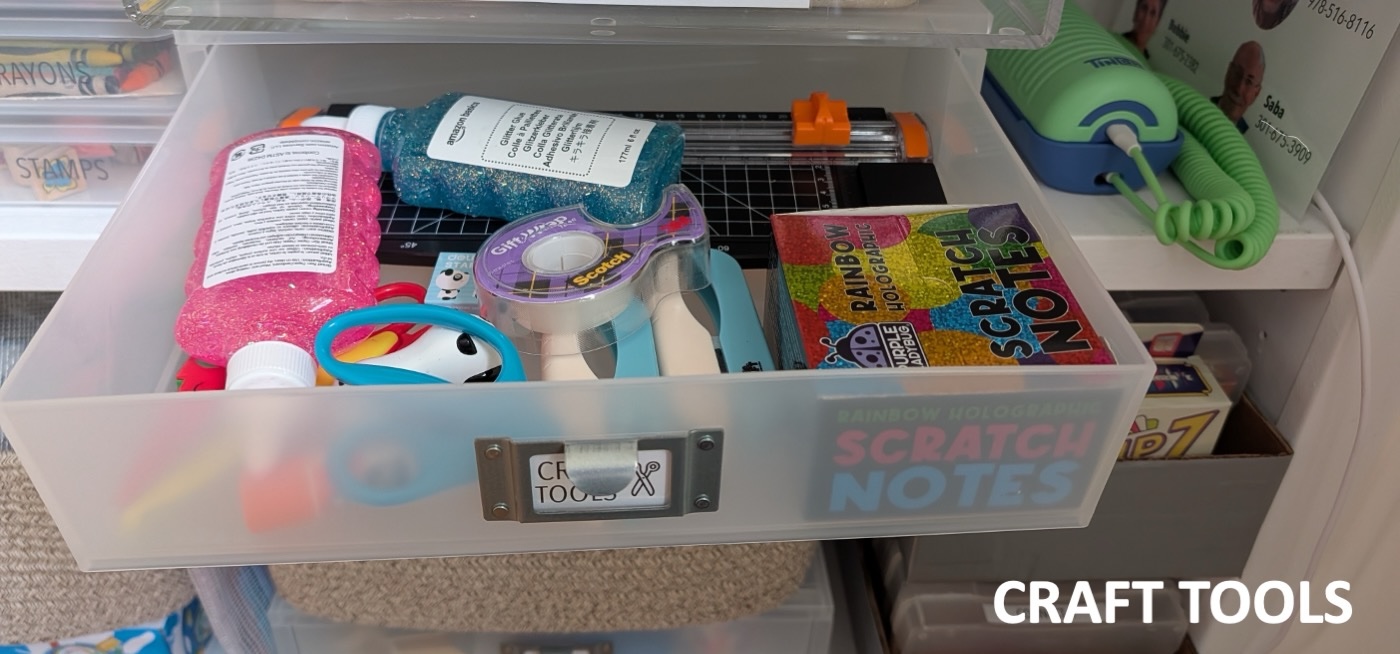
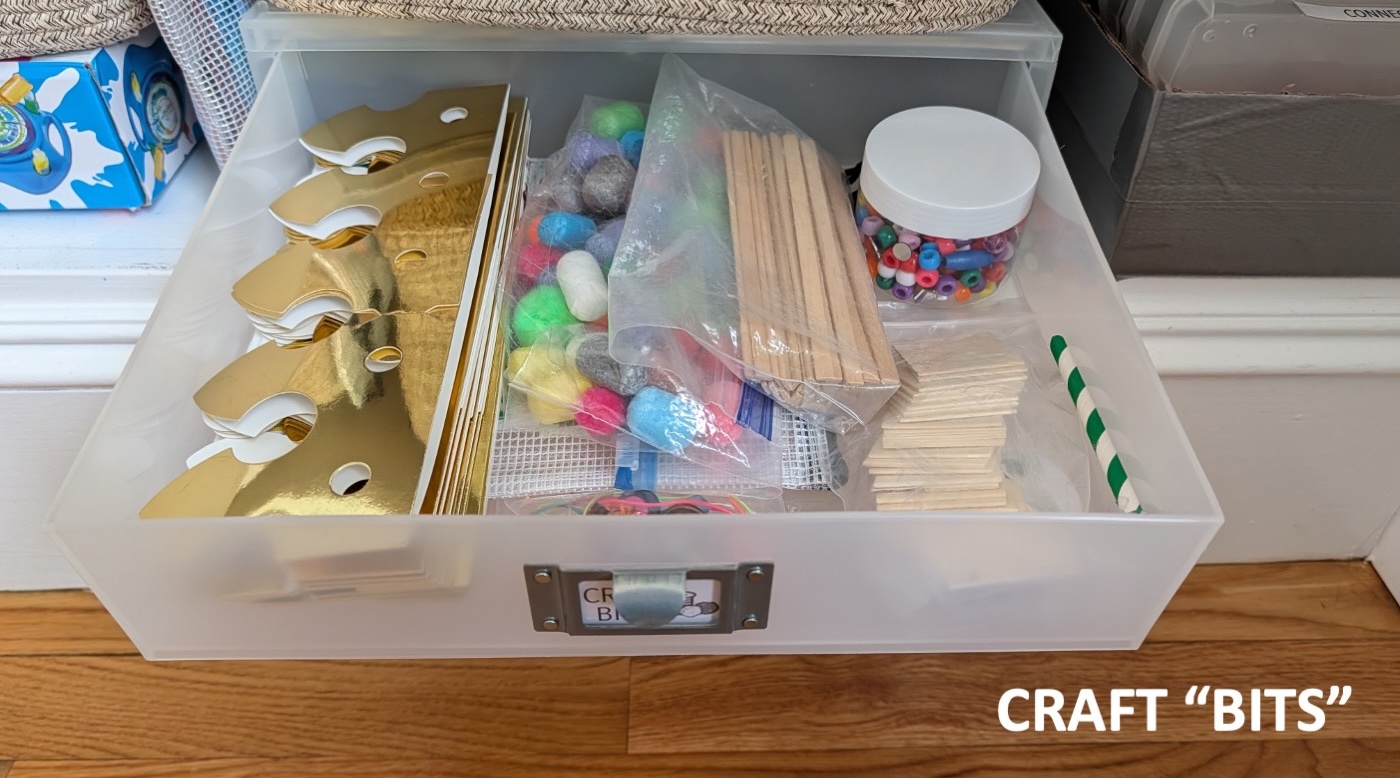
Separated “tools” from consumable “supplies” and sorted into pull-out drawers
|
 Craft Tools stores a paper cutter, regular kid scissors, pattern scissors, hole punchers, glitter glue, Scotch tape, a mini stapler, glue sticks, and scratch notes.
Craft “Bits” stores turnover items like beads, pom poms, stickers, pipe cleaners, and popsicle sticks. 

| Problem 2: Work-in-Progress | Fix-for-Now |
|---|---|
| 🚧 Half-finished craft projects are constantly left out on table. |
Preschool teacher suggests a “work-in-progress” tray. |
| ↳ … Space for small game boxes is gone to accommodate work tray. |
Installed L-brackets to stack games on DIYed short mini shelf |
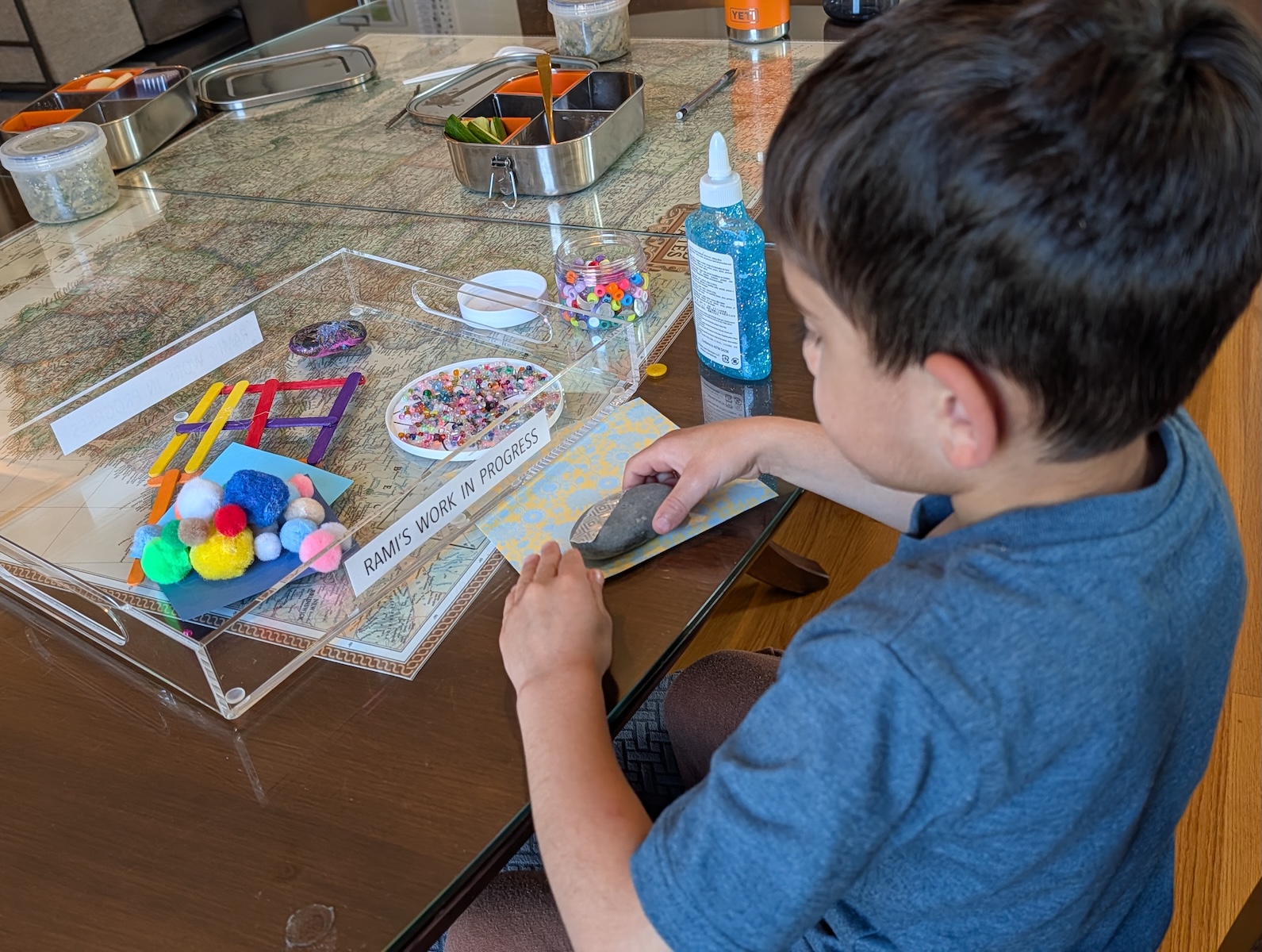 The “work-in-progress” tray has been a mixed success: Half-finished crafts are returned here
  …but rarely finished.

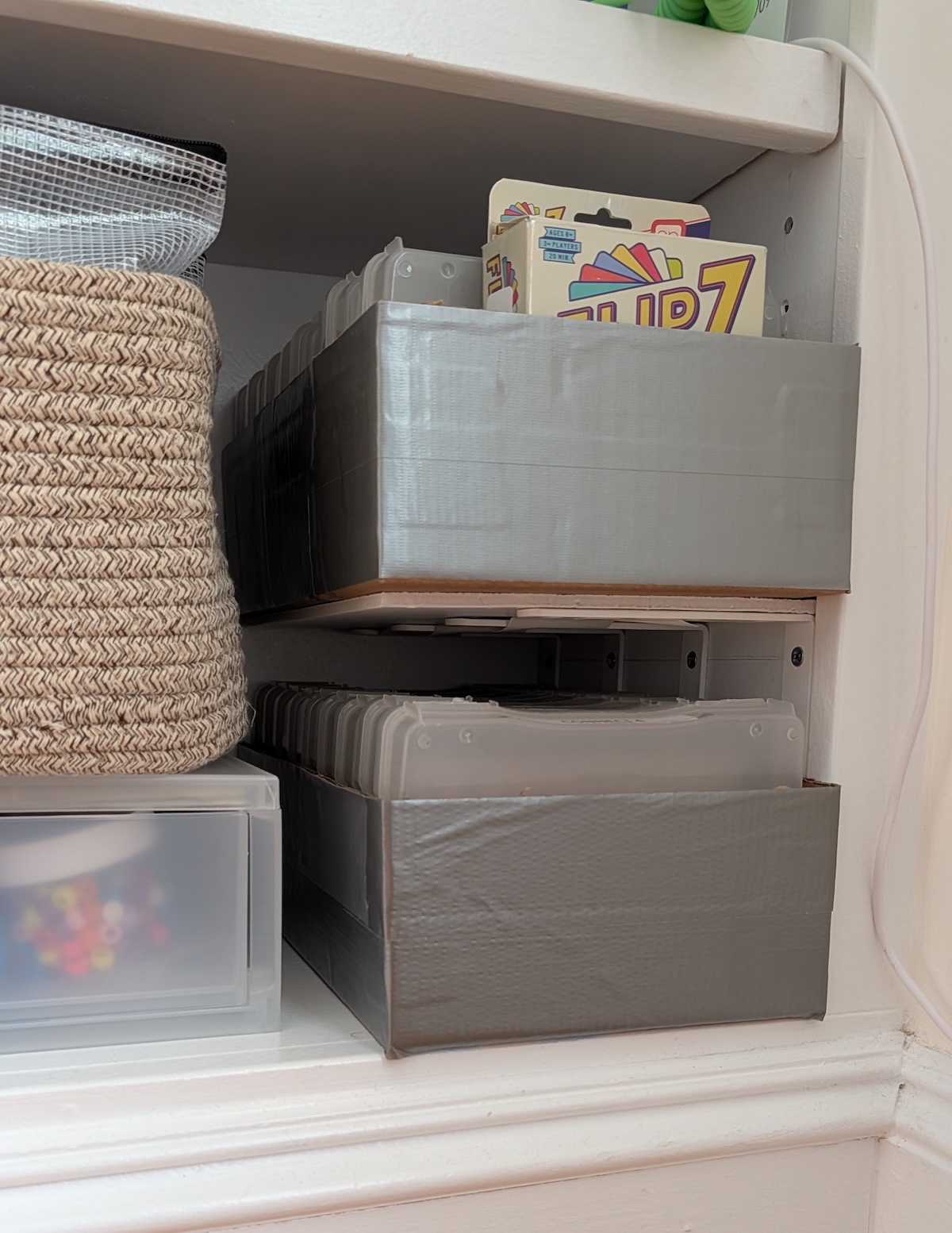 I made baskets from cardboard and duct tape (like for our upstairs games cabinet), since the kids were adamant about these card games staying here.


| Problem 3: Diverse writing implements | Fix-for-Now |
|---|---|
|
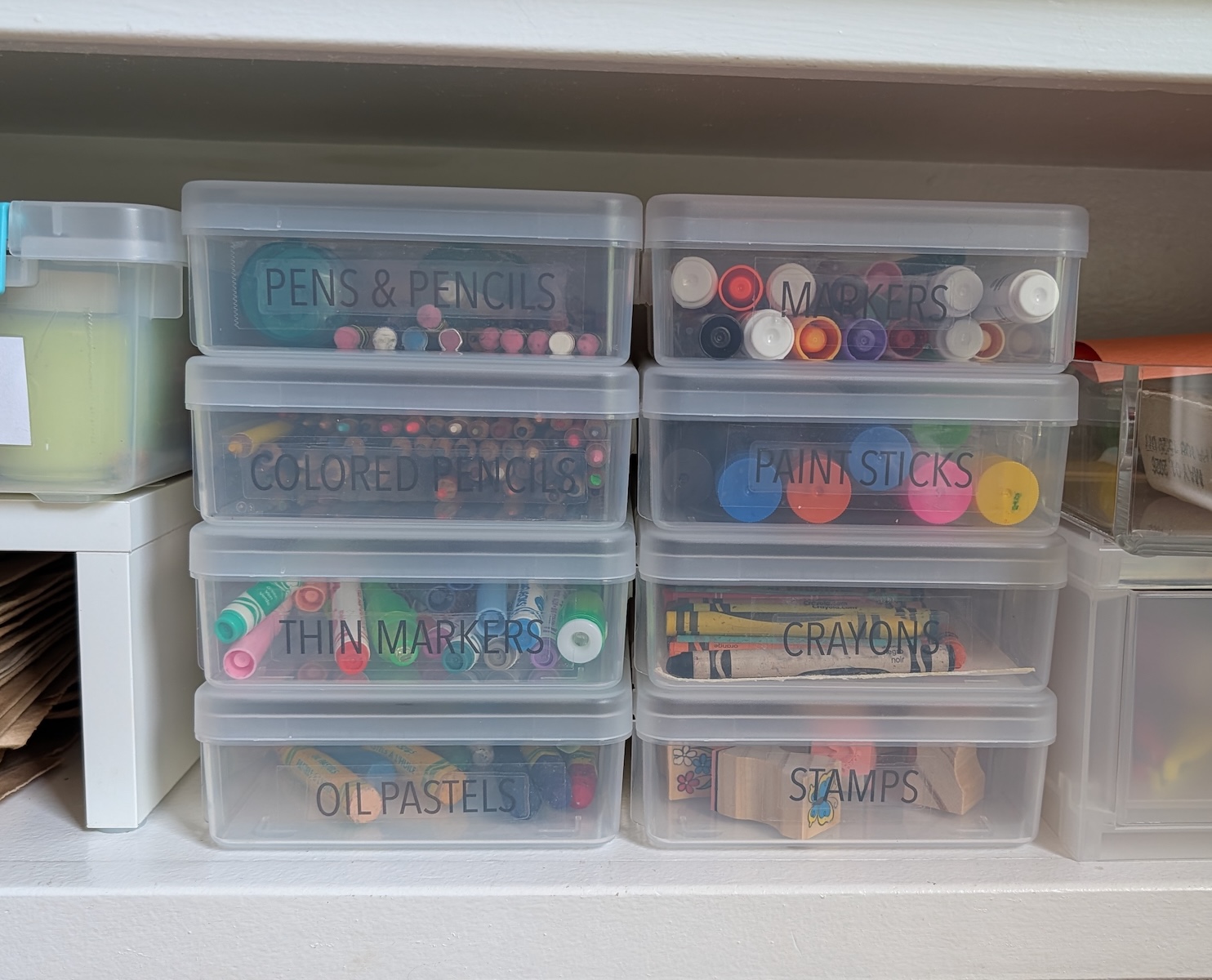
Too many actively-used art supplies, and existing boxes don’t stack deeply enough |
Found perfectly sized stackable pencil cases. |
| Problem 4: New phone! | Fix-for-Now |
|---|---|
 Kiddos want to call their own friends and grandparents Kiddos want to call their own friends and grandparents |
We got a Tin Can! (…it’s been amazing) |
↳ …  Phone isn’t wall-mountable and must be within reach, displacing some games Phone isn’t wall-mountable and must be within reach, displacing some games |
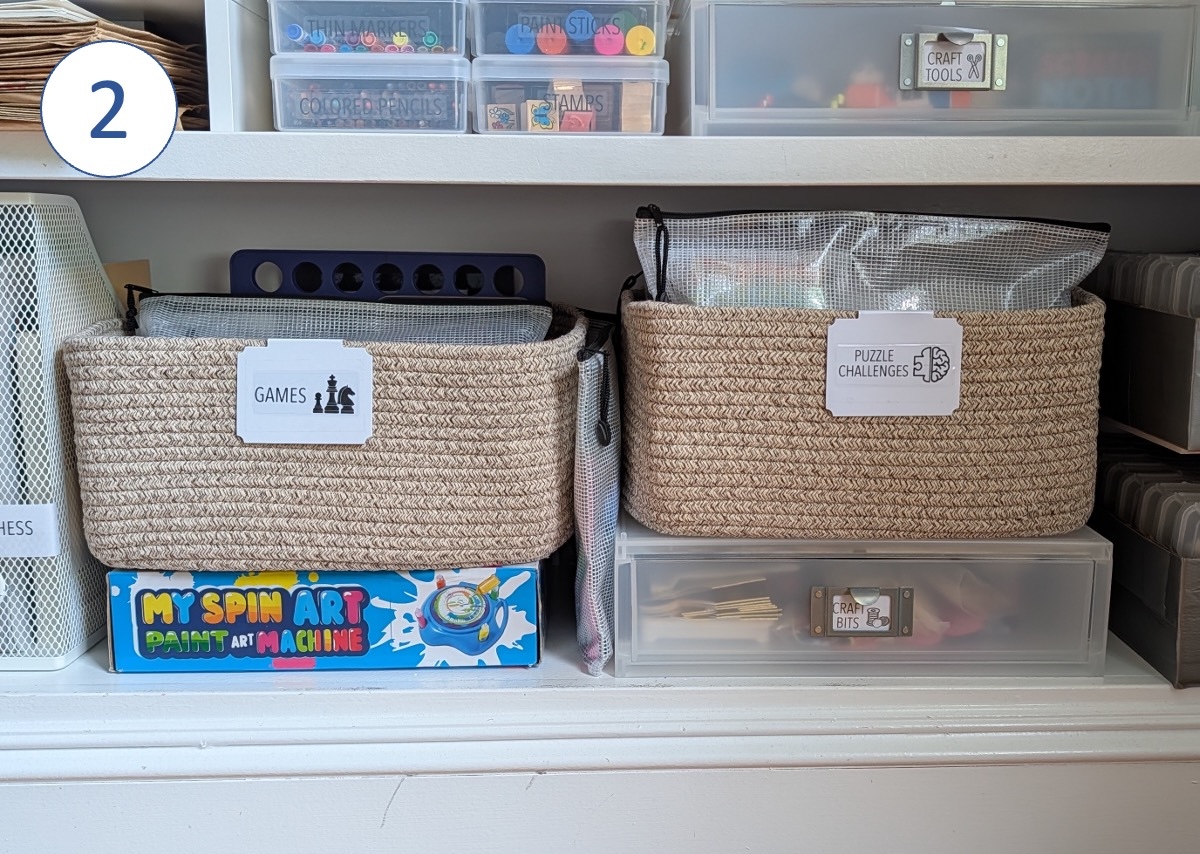
Moved games into cloth bins on lower shelf |
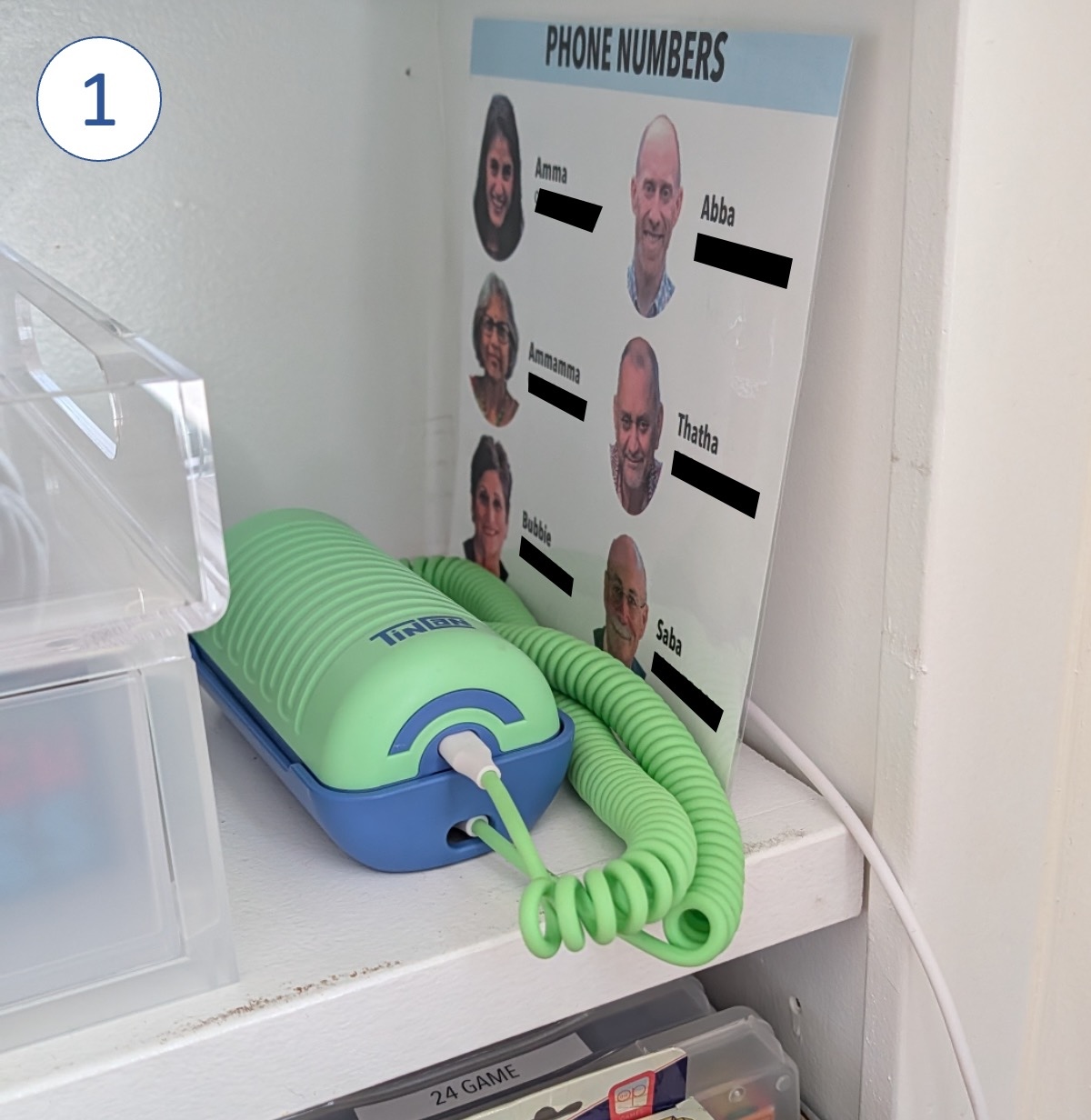 We bought the Tin Can so the kids could call family members (and memorize their phone numbers). Now, their friends are getting them, too, so they can call each other!
After donating and relocating games where possible, I divided what was left into two cloth bins: (1) partner / group games like Connect 4, Chess  and (2) individual puzzle challenge games like Gravity Maze, Laser Maze, Rush Hour, Happy Cube Pro, Chocolate Fix, Pentanimo.
| Problem 5: Third messy activity to store | Fix-for-Now |
|---|---|
|
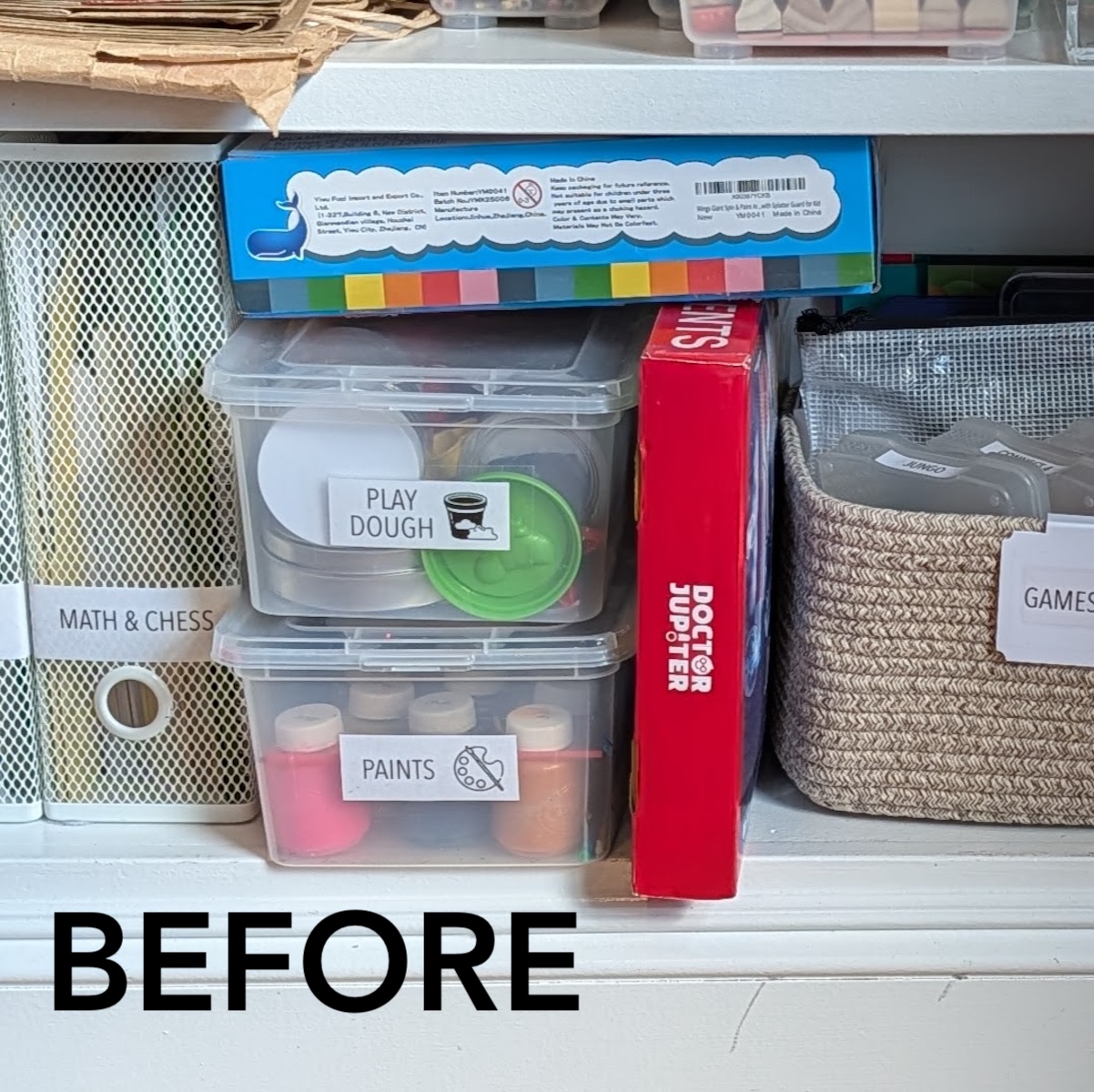
Paints and play dough need to be in sealable bins |
Found clear shoebox bins that stack! |
↳ …  New addition = science experiments! Box doesn’t fit, and should be stored upright. New addition = science experiments! Box doesn’t fit, and should be stored upright. |
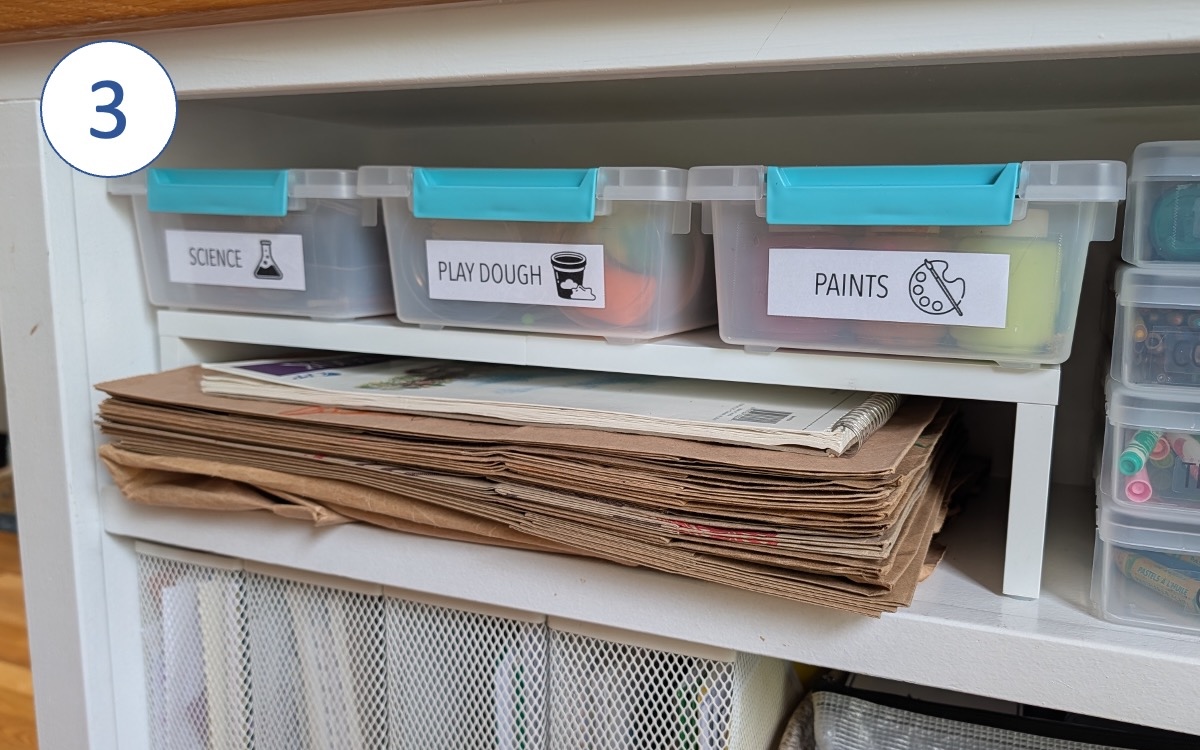
Used a monitor riser as a shelf to stack three click-shut boxes on top |
Paper grocery and takeout bags are easy to stash here and make excellent art canvases! However, 18”-wide cabinet shelves for stacking over them do not exist…  We’re using a computer monitor riser stand instead to stack these new click-shut bins above. And yes, this switch-up was totally worth it to accommodate our excellent science experiments kit!
Ongoing Feature Requests
I always knew that the storage solutions I implement will eventually need to be updated. My previous blog posts describe art solutions and toy storage for little kids. I love finding new fixes to foster independence for our older kids, too !
The current snapshot again (soon to be updated, I’m sure  ):
):

Shilpa Kobren is the Associate Director of Rare Disease Analysis at Harvard Medical School where she focuses on analyzing genomic sequencing data with patient clinical information to derive insights into human diseases. Shilpa lives in an 1890s urban apartment in Cambridge, Massachusetts with her husband and two energetic toddlers. She retains her sense of peace amid the chaos by creating and iteratively improving systems that optimize daily efficiency in her family's constrained living space.